
 por
por I have just launched my website menu page « NEWS ». For this occasion I have the pleasure to announce to you my first participation to the most important panoramic photography competition worldwide, the Epson Pano Awards. I have selected four pictures that I submitted to the Open Awards and the Amateur Awards. We’ll see if the judges are sensitive to my photography. Results are expected for end of september. Whatever comes out, I’ll keep you informed. Thanks for all the messages of support. Following is a brief description of each picture.
« Mountain Light »
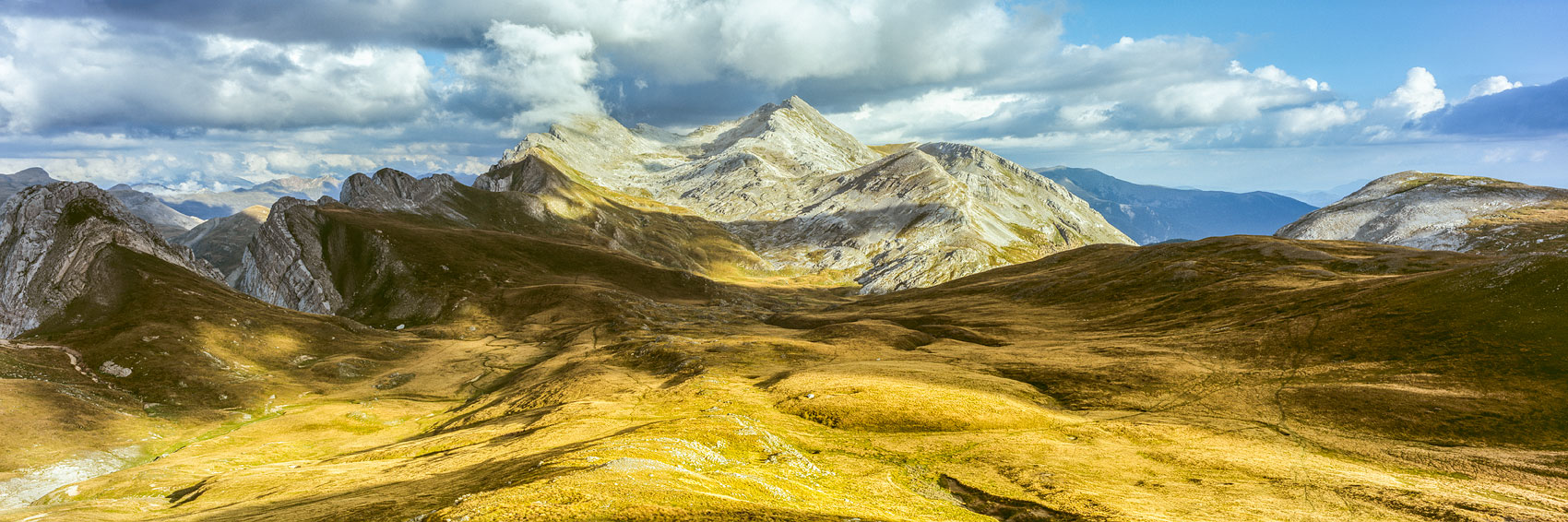
This picture is a special dedicasse to inspiring photographer Galen Rowell, whose book Mountain Light, where he describes his love for adventure and his photographic philosophy, played a major role in my life. I wouldn’t certainly be a qualified mountain guide today, if I hadn’t been touched by Galen’s sincerity and straightforward advices on photographying the mountain world.
Its title is a nod to Galen too, as I made it with my cumbersome camera, the FUJI GX 617, whereas he was especially criticizing the landscape photographers of his time for limiting their creative capacities by carrying medium format cameras and unnecessary heavy gear. Galen applied the philosophy « fast and light » to photography before everyone, which helped him to capture the most amazing lights during his multiple adventures in the mountains in North America and Asia. He opened a new world for sport photography by using light 35 mm cameras and wideangles to take climbers in impossible situations on the Yosemite walls. Even during his regular hikes looking for landscape pictures and for long exposures, he wouldn’t even bother with a tripod.
Despite the fact I still search new pictures when I go hiking, I sincerily think this one could be my ultimate photograph to express the magnificence of the mountain light.
« Purple Rain »

This picture was taken at sunrise in Northern Spain. While it had been raining for weeks, I was craving for colourful sunrises, like those I witnessed in Australia, that the famous panoramic photographer Ken Duncan was able to capture. Nonetheless, in this part of the world, you can count those days on the fingers of one hand. Effectively, when the southerly wind blows, only at certain times of the year, in winter and less regularly in spring, the impossibe can happen. After the passing of an active front with strong rains, that morning the sky was still mindblowingly covered with big clouds that progressively reflected the colour cast of dawn during the two-minute exposure.
But before actually making it, I was waking up at 5 A.M and going down to the beach every morning during one month, desperately waiting for the exceptional to happen. A burst of reddish clouds occurred a few times, but nothing spectacular. With a lens covering an horizontal angle of nearly 90 degrees, you only look for the best conditions to make such shots. If the wind blows too much, clouds are very likely to disappear and the sky will look empty. So I could not be happier with that perfect match between the warm and gentle southerly, the mid-tide line and the big clouds’ shapes doing for a perfect composition.
So if you go to Northern Spain you will probably get stormy conditions, thick clouds and pouring rain. But don’t worry and wait for that unexpected change of the rainy clouds into purple silk and hope to make a shot that will stimulate your photographic journey and take you to new horizons.
« The Kings’ Path »

I made this picture in an environment full of history. The picture itself is of an old bridle path called after the name of the King Alfonso XI de Castilla (1311-1350), and runs between the towns of Navezuelas and Guadalupe, in the wonderful landscape of the Villuercas Sierra in Extremadura, Spain. Anciently connected to the Apalachian Mountains more than 300 million years ago, it is formed by intimate paralel valleys which are a haven of peace.
Alfonso XI was a fierce actor of the Reconquista and after winning the Battle of El Salado and visiting the small church of Guadalupe in 1330, the place turned into a destination for pilgrims and was converted into a Monastery where later, in 1486, the Catholic Kings gave Christopher Columbus the offical permission to explore the western sea passage to the East Indies.
I tried to convey my emotional and spiritual response to the scene the first time I discovered it. I stepped upon this path while hiking in search of a close-up picture, like the king Alfonso XI who used to hunt bears in those woods in his time. I decided to go back the day after with the right conditions and my camera. Uncounsciously driven by the place’s atmosphere, I composed the picture during one hour and a half before making the first shot. I hope you can feel the mystery of those woods and lands full of terrestrial forces and history.
« Cathedral Canyons »
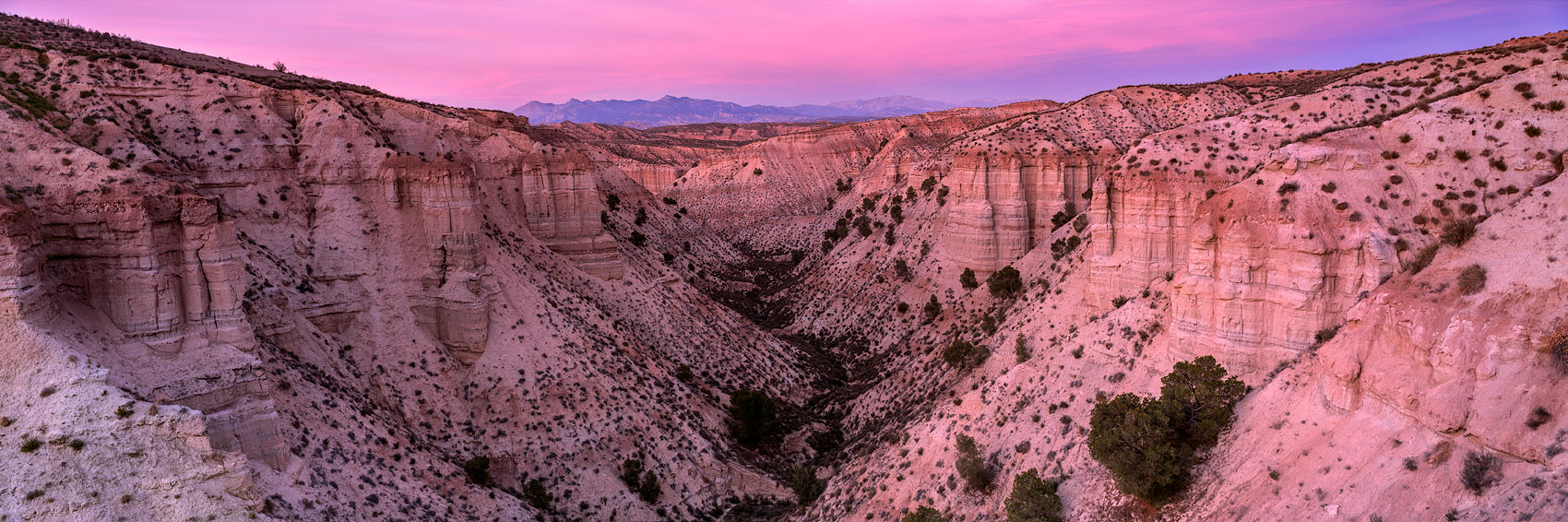
When I first discovered this unknown part of Spain, I felt blessed with such a privilege. Despite spending a month for my first time there and making two great pictures, it had such an impact on me that, even a year after, I kept dreaming about coming back to spend more time. How did I figure out how to make this image ? Well, by undergoing a process during which I slowly let myself empowered by the place’s changing beauty, day after day.
Everything went perfectly well for me there as, on my second day, I had already made a great picture of this peculiar landscape bathed into a really charming light. But I wanted to keep exploring the potential of the place. So I wandered through every possible part of those deep canyons and, after three weeks, I had a photographic revelation. Intrigued by their fabulous shapes, I was feeling these canyon walls were the pillars of a natural cathedral, where I came looking for silence and inner peace. Seeing these naturally sculptured pink clay walls reflecting all the possible colour casts of the sky, from orange to red, pink and yellow, depending on the weather conditions, was an unsurpassable feed for my creative imagination.
That’s why I decided to wait for a beautiful sunset to send its glow onto the surface of the canyons. It finally happened on my last day, after a warm afternoon and finding the perfect setting with the twilight in my back. Despite of being a simple centered composition, it took me a lot of effort to balance the top of each part of the canyon to give a sense of symetry. My concern was to keep a good distance between each column on the left-hand side too, in order to highlight the morphology of the place, whereas on the right-hand part the pillars inevitably overlapped, wherever I was standing.
 fotomonte.com