
 por
por We collect memories in the form of still images, sounds, smells and feelings. The impact the « decisive moment » has on us in the long run mostly depends on how much attention and how focused we were at that time on our subject. The more proficient you get technically the more present you get emotionally. I remember the detailed story behind all of my shots by simply viewing the final picture years after.
“We photograph things in order to drive them out of our mind.” Franz Kafka
Even if we do photograph things to drive our desire for them out of our mind, I think we photograph things to keep them with us for eternity and in a desperate struggle against death too. The more I shoot landscape pictures, the more I am counscious about our fragility and all this can end tomorrow. Photography is an illusory means of escaping that only reality we are all equal to.
If you want to master the technical side, and focus on the moment, a good way to learn is to see how different camera settings affect the results. The live view mode gives you an instant feedback with the histogram and useful technical datas. Before digital, only a few cameras were able to print on the frame of the film datas like aperture, speed or film sensitivity.
My Fuji GX 617 doesn’t, so I have to write everything down on a notebook. When I was starting, I spent a great deal of my time preparing the photo session on the spot and anticipating the changing light conditions. I wanted to know the limits of my medium, like time exposure and reciprocity failure, and had to experiment with filters and the Zone System. I was concentrating a lot and was very picky with light conditions. Because of film costs, I have learned to nail my exposures and know exactly what I want in a matter of weeks. Now, I don’t necessarily keep a track of every exposure and paradocically I am not as thrifty with film rolls. I’d rather spend more on rolls than miss a shot after a 4 hour hike in the mountains with 15 kilos on my back. For long exposure subjects like sunrises though, still you cannot fail, because the exposure can be as long as the burst of colours of the clouds itself, and does not let you another opportunity.
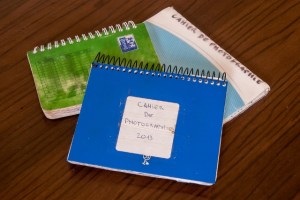


As a consequence, when I take a glimpe at my previous photography notebooks, by simply reading them I can remember how difficult was such or such shot and all the stories behind each one. And realize how far I have gone since my beginnings in 2013. Each of them reflect how important is good planning to any kind of photography and the importance to manage exposure for highlights, shadows and midtones with film especially.
Finally, I would like to quote Ansel Adams, who, in the chapter ‘Frozen Lake and Cliffs’, in his book Examples : The Making of 40 photographs, sums up the relationship between our memories of a scene and our experience of it :
“With all art expression, when something is seen, it is a vivid experience, sudden, compelling, and inevitable. The visualization is complete, a seemingly instant review of all the mental and imaginative resources called forth by some miracle of the mind-computer that we do not comprehend. For me, this resource is not of things consciously seen or transcriptions of musical recollections; it is, perhaps, a summary of total experience and instinct. Nothing modifies or replaces it.”
 fotomonte.com